


















Philippine economic slowdown deepens in Q3
THE PHILIPPINE ECONOMY posted its slowest growth since the pandemic in the third quarter, extending its slowdown to five straight quarters amid sluggish household consumption, lower agricultural output and muted investments, the Philippine Statistics Authority reported on Monday.


By Justine Irish D. Tabile, Senior Reporter
THE PHILIPPINE ECONOMY posted its slowest growth since the pandemic in the third quarter, extending its slowdown to five straight quarters amid sluggish household consumption, lower agricultural output and muted investments, the Philippine Statistics Authority reported on Monday.
Gross domestic product (GDP) expanded by just 2.1% year on year in the July-to-September period, slowing from 4% in the same period last year and the revised 2.4% in the second quarter.
The third-quarter print was below the median GDP growth estimate of 2.7% in a BusinessWorld poll of 16 economists and analysts conducted last week.

This was the slowest GDP growth since the 3.8% contraction in the first quarter of 2021, during the coronavirus pandemic. Excluding the pandemic years, this was the weakest in over 16 years or since the 1.8% expansion in the fourth quarter of 2009.
On a seasonally adjusted quarter-on-quarter basis, GDP inched up by 0.1%, further easing from the 0.6% expansion in the previous quarter.
The third-quarter performance brought GDP growth in the first nine months to 2.5%, well below the government’s 3.5%-4.5% full-year target.
Economy, Planning, and Development Secretary Arsenio M. Balisacan said the government would now find it challenging to meet its target.
“Growth would nevertheless need to reach about 6.3% in the fourth quarter to achieve the lower end of the government’s 3.5-4.5% annual target,” Mr. Balisacan said.
“Recovery toward next year’s 5-6% target remains possible but requires stronger investment, easing price pressures, and renewed confidence. Energy shocks, El Niño, and implementation delays remain risks,” he added.
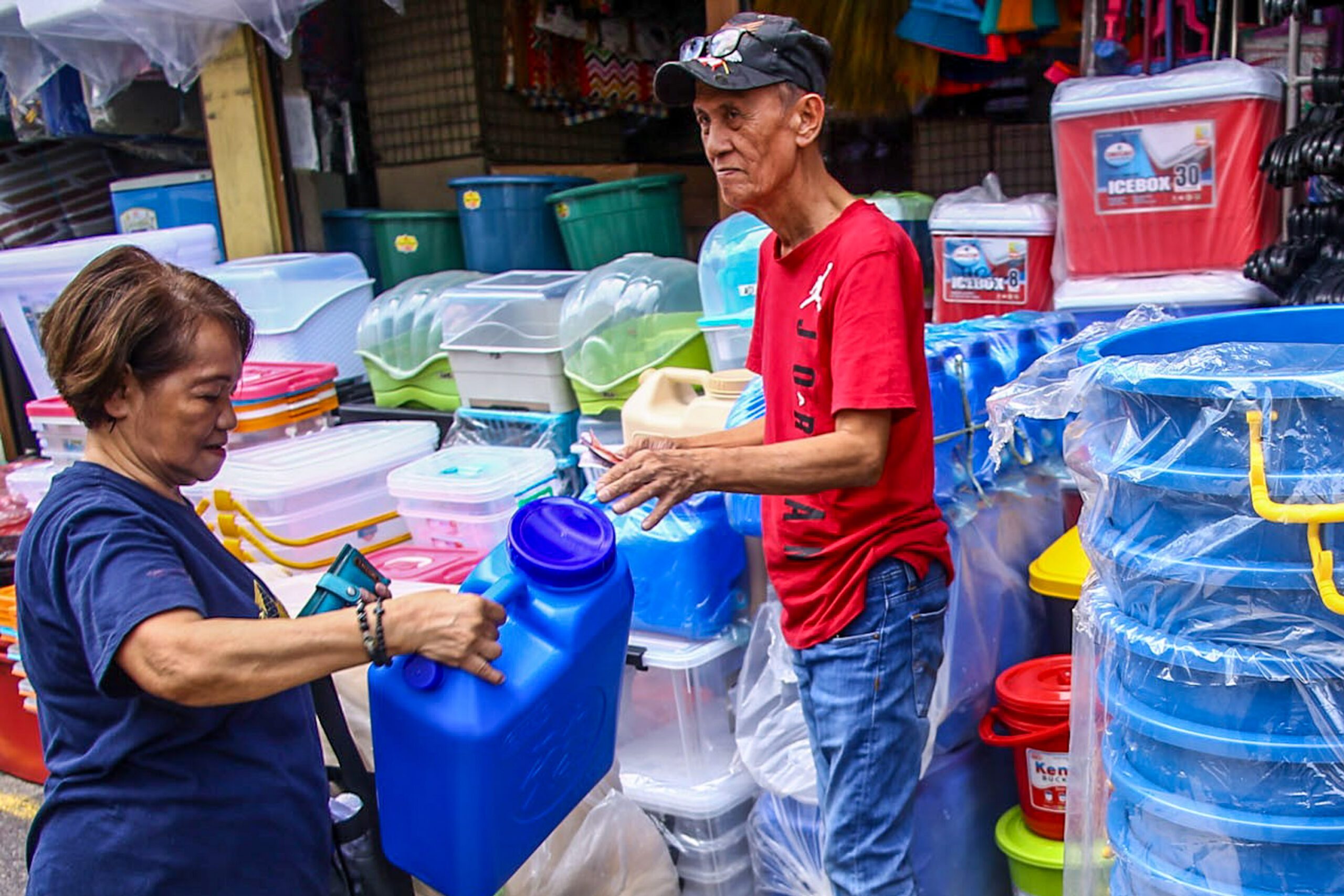
On the demand side, household final consumption expenditure — a key driver of the economy — grew by 2.4% in the third quarter, further slowing from the 4% print in the same quarter last year and 2.9% in the previous quarter.
This was the weakest pace since the 4.8% contraction in the first quarter of 2021. Excluding the pandemic, this was the slowest growth in consumption since the 2.1% expansion in the second quarter of 2010.
“High food and energy prices constrained household spending… The Middle East conflict raised fuel costs, affecting transport, electricity, and production. Inflation of 7.8% in October underscores the continuing pressure on purchasing power. Tighter financing conditions also weighed on investment,” Mr. Balisacan said.
Gross capital formation contracted by 0.2% in the third quarter, easing from the 2% decline in the same period last year and the revised 8.8% contraction in the second quarter. However, it was still the fifth consecutive quarter of contraction.
“Investment remained subdued. Public construction declined for the sixth consecutive quarter, although its contraction eased to 15.1% from 33.4% (in the second quarter),” Mr. Balisacan said.
Private construction was also flat. Construction by financial and nonfinancial corporations inched up by 0.3%, sharply slowing from 14.4% a year ago and 4.3% in the previous quarter.
Investment in durable equipment fell by 7.8% in the third quarter, reversing the 2.1% expansion a year earlier but easing from the 12.8% contraction in the second quarter.
“Weather disruptions and delays in project validation and payments constrained infrastructure delivery. These delays affected contractors’ capacity to pay workers, purchase materials, and undertake further work,” Mr. Balisacan said.
He also noted that governance concerns and uncertainty also weighed on confidence. This reflected the lingering impact of last year’s flood control corruption scandal.
“The easing contraction in investment provides a possible starting point for recovery. Faster project implementation and lower fuel prices, if sustained and reflected in domestic costs, could support a fourth-quarter pickup,” the Department of Economy, Planning, and Development (DEPDev) chief said.
On the other hand, government final consumption expenditure grew by 6.8% in the July-to-September period, faster than the 5.8% expansion last year but slower than the 8.3% growth in the second quarter. Exports of goods and services rose by 8.6%, outpacing the 7.7% growth in imports.
WEAK PRODUCTION
On the supply side, agriculture, forestry and fishing (AFF), which accounted for the smallest share of GDP among the three major economic sectors at 6.9%, contracted by 4.8% in the third quarter. This was a reversal of the 2.87% expansion in the same period a year ago and 2.93% growth in the previous quarter.
“Agriculture contracted by 4.8% as tropical cyclones and the enhanced southwest monsoon disrupted production. Palay and corn output fell by more than 17%, reducing rural incomes and adding to food supply pressures,” said Mr. Balisacan.
Other AFF sub-industries also posted year-on-year declines such as sugarcane (48.4%), abaca (11.6%), fishing and aquaculture (8.5%), mango (8.2%), and cassava (5.3%).
Industry was nearly flat in the July-to-September period at -0.003%, reversing the 0.7% growth in the same quarter last year but an improvement from the 2.4% contraction in the second quarter.
In terms of its share of the total economy, industry accounted for 25.3% in the third quarter.
Construction was the main contributor to industry’s decline, shrinking by 4%. Manufacturing growth also slowed to 0.7% from 1.3% a year ago and 2.6% in the previous quarter.
“Manufacturing nearly stagnated, growing by just 0.7%, as high input costs and weak demand weighed on activity,” Chinabank Research said in a commentary on Monday.
Meanwhile, services, which had a 67.8% share in the total GDP in the third quarter, grew by 3.7%, slowing from 5.5% a year ago and 4.5% in the second quarter.
Gross national income posted annual growth of 2.7% in the third quarter, slower than 5.4% a year ago but faster than 2.2% in the second quarter.
Net primary income from the rest of the world grew by 6.6% in the third quarter, much slower than 15.8% in the same quarter in 2025 but faster than the 0.8% in the previous quarter.
STAGFLATION CONCERNS
The GDP report comes after data showing October inflation accelerated to the 7.8%, the fastest in nearly four years. The faster inflation print strengthens the case for another jumbo rate hike, after the Bangko Sentral ng Pilipinas’ (BSP) 50-basis-point hike last month.
Mr. Balisacan said the recent interest rate hikes’ impact on the economy would unfold over the coming months.
“If the BSP actually succeeds in anchoring the inflation expectation back to the target, then that actually will impact positively on consumption and investment,” he said.
“So, it’s not necessarily bad for growth. It depends on how credible that action is and effective that action is in managing, shaping those expectations,” he added.
October had marked the eighth straight month that inflation was above the BSP’s target.
Asked whether sluggish economic growth and elevated inflation meant the economy was entering a period of stagflation, Mr. Balisacan said he would wait until yearend before making an assessment.
“I think I would wait for the end of the year to think of stagflation,” he said, adding that there is a need to consider other dimensions of the economy.
Mr. Balisacan said the economy’s potential growth remained between 5% and 6%, adding that measures needed to bring growth back to that potential remained within reach.
Chinabank Research, meanwhile, said the Philippine economy was edging closer to stagflation and expects the BSP to be more cautious about further rate increases, even if inflation reaches around 8% in November.
“With a sizeable negative output gap and weak domestic demand, additional tightening would unduly burden growth without addressing supply-side inflation pressures,” Chinabank said.
Capital Economics also said that the BSP might keep interest rates unchanged at its Dec. 17 meeting.
“The weakness of the economy supports our view that the central bank’s tightening cycle is now probably over despite the recent jump in inflation,” Capital Economics Senior Asia Economist Gareth Leather said in a report.
On the other hand, Bank of the Philippine Islands Lead Economist Emilio S. Neri, Jr. said weak GDP growth presents a difficult challenge for the BSP, but expects the central bank to continue tightening.
“While additional rate hikes may weigh on GDP in the near term, restoring price stability with the help of monetary policy could support a faster and more sustainable recovery in economic growth,” Mr. Neri said.
“Failure to hike in a timely manner could also contribute to FX (foreign exchange) volatility given the significant probability of additional rate hikes from the US Federal Reserve after the release of the strong US employment report,” he added.
DBCC TO REVIEW TARGETS
With growth still below the government’s full-year target, Mr. Balisacan said the Development Budget Coordination Committee (DBCC) would meet in early December to review its growth assumptions and targets.
He said the review would take into account the latest economic growth, inflation, and employment data.
Chinabank Research said it now expects full-year GDP growth of around 2.6%, below the government’s 3.5%-4.5% target.
“We expect economic growth to remain weak, if not deteriorate further, in Q4,” it said. “Household spending will likely stay subdued amid elevated living costs, while public infrastructure spending remains a drag.”
“Private construction could also contract as higher interest rates weigh on investment, keeping overall growth subdued,” it added.
Capital Economics, meanwhile, expects GDP growth of around 3% this year before gradually picking up in 2027 and 2028.
Mr. Leather said the narrower investment contraction suggested that the economic impact of the corruption scandal was starting to ease.
“Looking ahead, however, while the worst may now be over for investment, the recovery is likely to be slow, with weak business confidence likely to hold back spending by companies,” he said.
For the fourth quarter, Mr. Balisacan said the government is banking on public investment to drive growth, citing its multiplier effects and its influence on private investment and consumer and business confidence.
However, the DEPDev chief said consumer spending is unlikely to rebound strongly soon, citing elevated inflation and its lingering effects.
“The inflation is still high and well, I think that for November, inflation will continue to be challenged because of the lag effects of the previous increases in prices of goods and services,” he added.
However, he expects public construction to return to growth in the fourth quarter as agencies spend available infrastructure funds and processes improve.
Mr. Balisacan said the government would work with Congress to secure the timely passage of the P7.2-trillion national budget for 2027.
“There were questions about the 2026 budget. We don’t want to enact a budget that already has questions to begin with, right?” he said, noting that the Congress is working hard to ensure that the budget will be approved on time.
Senate Finance Committee Chairperson Jose Victor G. Ejercito earlier warned that recalling the House-approved budget bill could jeopardize its passage by yearend, citing a tight legislative calendar that includes the resumption of Vice-President Sara Duterte’s impeachment trial.
For 2027, Chinabank Research said lower oil prices, reduced geopolitical risks and potentially less uncertainty over US policies could improve the economic outlook.
“Exports remain the lone bright spot for the economy, driven by strong global demand for semiconductors,” it said. “However, export strength from a relatively narrow segment of the economy is insufficient to drive a broad-based recovery. More investment in productive and job-generating activities will be essential to strengthen domestic growth.”
What's Your Reaction?