





















Solar for whom? What Philippines can learn from Pakistan’s rooftop boom
As rooftop solar begins to catch on in the Philippines, Pakistan shows why the country must make sure the boom reaches more Filipinos without leaving the power grid struggling to keep up

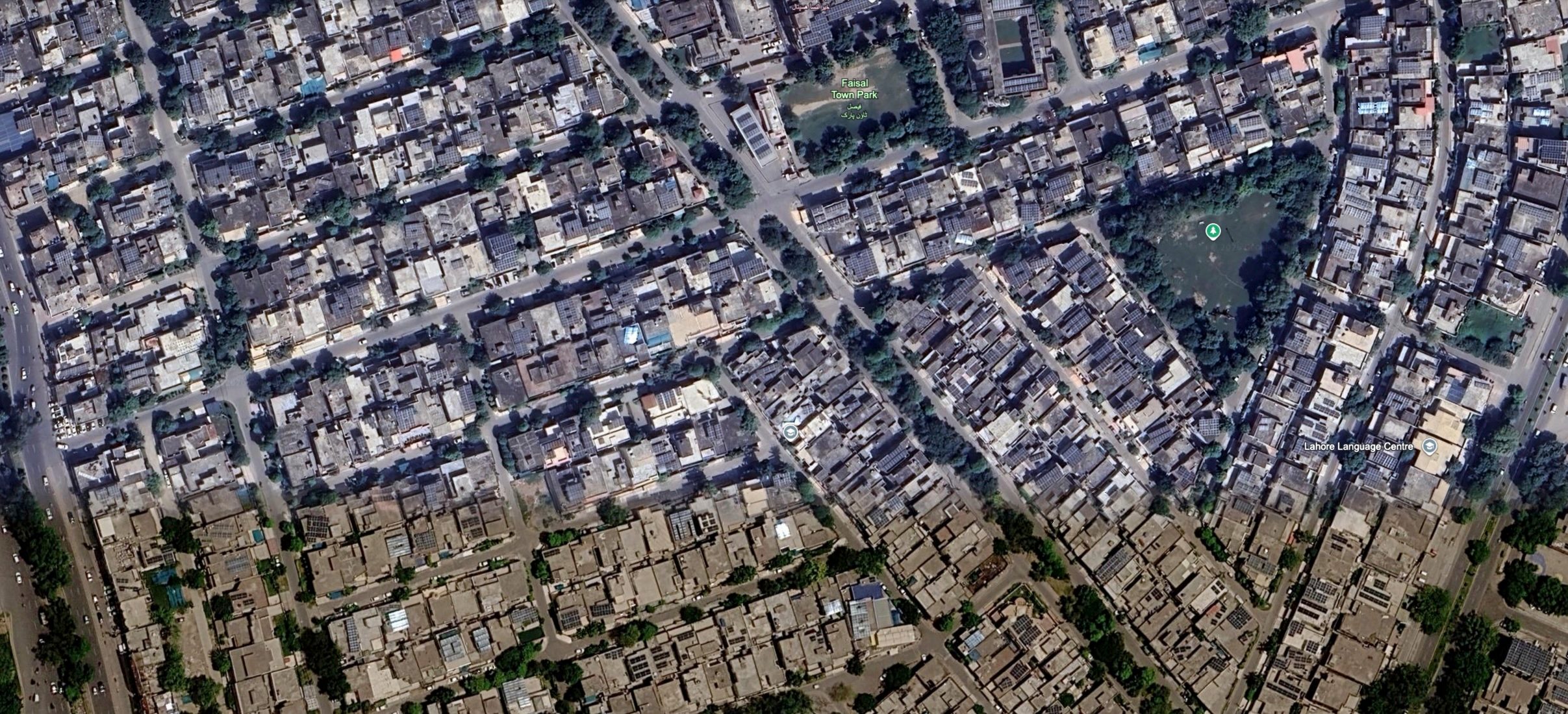
From above, Lahore appears to have changed one roof at a time.
Satellite images of the Pakistani city showed mostly bare concrete in 2021. Three years later, blue-black solar panels started covering roof after roof, in some neighborhoods almost forming a second skin over the city.
The change did not stop with wealthy subdivisions. Panels spread to farms, rural communities, even boats that had never enjoyed reliable grid electricity.

The Philippines is nowhere near that scale yet. But we’re already starting to see the same conditions that helped create Pakistan’s solar rush: expensive electricity, cheaper panels, strong consumer interest, and support from the government.
“Right now, the growth in solar rooftop is exponential,” Energy Regulatory Commission (ERC) Chair Francis Juan told Rappler in a mix of English and Filipino. “Part of the reason is the electricity rates and retail rates are so high that if you have solar rooftop available, you invest in that installation, you will not consume from the grid.”
Juan estimated that consumers could save P13 to P14 per kilowatt-hour (kWh) while investment costs would only be about P7 to P8 per kWh. The time it takes to recoup your initial investment has also accelerated now that solar panels are cheaper and more efficient, shortening from five to seven years to as little as three.
ERC data also show that registered net-metered solar is already well beyond Metro Manila. Of 24,483 solar Qualified End-Users on the August 31, 2026 lists, around 18,500, or roughly 76%, were outside the National Capital Region, with particularly large counts in Pampanga, Cavite, Negros Occidental, Bulacan, Laguna and Rizal.
Those numbers are still small in a country with nearly 30 million households. But this growth is happening with incredible momentum. Net-metering registrations increased by 248.75% from August 2025 to June 2026, meaning the formal market more than tripled in less than a year.
That’s not even the full picture as these figures cover only those with certificates of compliance under the net-metering program, rather than every rooftop or distributed solar installation.
Utilities are noticing. Meralco estimated that rooftop systems generated 372 gigawatt-hours (GWh) for their owners’ own use in the first half of 2026, while its distribution sales slipped 0.5% from a year earlier.
Even Manuel V. Pangilinan — chairman of the Philippines’ biggest power distribution utility and of the company behind what is set to become the country’s largest solar farm — knows rooftop solar will make it big.
“It’s coming. It’s part of the technology trend,” he said of distributed solar at Meralco’s own H1 2026 briefing.
Yes, it’s coming, but the Philippines doesn’t have to discover and overcome every challenge on its own. Pakistan has already lived through it.

Why rooftop solar took off
Pakistan’s rooftop boom didn’t begin with one sweeping government program. One might argue it took off because the economics tilted in its favor.
In Pakistan, electricity prices climbed 155% from 2021 to 2024, just as global solar module prices fell by roughly half. Not only was grid electricity becoming more expensive; it was also unreliable. Outages could last 8 to 13 hours a day, according to Khalid Waleed, a research fellow and energy expert at the Sustainable Development Policy Institute.
By the time solar really took off, the conditions had been building for years.
“Things were cooking,” Zeeshan Ashfaq, chief executive officer of Islamabad-based energy think tank Renewables First, said in a recent seminar. What followed was “bottom-up and market-driven.”
By June 2025, Renewables First estimated Pakistan had around 38 gigawatts (GW) of distributed solar, nearly as much as its utility-scale generating capacity. Yet only 8.3 GW was registered under net metering by December. Much of the boom was happening behind the meter, faster than official statistics could capture it.
The Philippines is still far from Pakistan’s scale, but a similar blind spot may be emerging.
Energy think tank Ember estimated Philippine rooftop solar may already have reached 1.3 GW by early 2026, nearly double the 721 megawatts (MW) estimate a year earlier by nongovernmental group Institute for Climate and Sustainable Cities (ICSC). Nevertheless, it already suggests the ERC’s net-metering tally may capture only part of a much larger rooftop market.
Who gets left behind in a solar boom?
In Pakistan, solar has spread beyond affluent households, but the way it’s used differs.
The country’s latest census in 2023 showed 26.4% of households in Balochistan — the vast, underdeveloped province bordering Iran and Afghanistan — reported solar as their main source of lighting. That’s much higher than the 12.6% in Sindh, the province which includes Pakistan’s economic capital Karachi, and just 2.2% in Islamabad, the national capital.
The contrast was almost the reverse for grid electricity, which reached 96.7% of households in Islamabad but only 57.1% in Balochistan.
Zain Moulvi, research director of the Alternative Law Collective, cautioned that high solar use in poorer and less-connected areas did not mean households were enjoying the same kind of systems as wealthier users.
In Balochistan and Sindh, many poorer households owned only a few panels, often enough for basic lighting rather than a full household system. Moulvi described these as “very small amounts of panels” providing “very minimal lighting.”
Financing widened the gap. Waleed said remittance-receiving households were about 44% more likely to own solar, while Moulvi said many poorer families and farmers went into debt to buy panels. A 2025 nationwide survey by the Policy Research Institute for Equitable Development also found a sharp divide in solar adoption, depending on a household’s financial situation.
At the extremes, solar adoption stood at 38% among households spending up to PKR 15,000 (P3,403.07)* a month on electricity, compared with 88% among those spending more than PKR 50,000 (P11,343.58).
The Philippines faces a similar affordability gap. A May 2026 Pulse Asia survey commissioned by the ICSC found that 91% of Filipinos agreed that switching to solar would be possible if financing and more affordable payment options were available.
And make no mistake, the upfront costs remain quite steep. Current industry estimates put fully installed residential solar without batteries at P45,000 to P65,000 per kilowatt-peak (kWp).

Adding batteries for backup power costs another P150,000 to P400,000. Batteries rarely pay for themselves through savings alone, but may make sense where brownouts are frequent. A 5-kWp system also needs roughly 28 to 45 square meters of usable, unshaded roof space.
In high-rate areas serviced by Meralco, grid-tied systems can sometimes repay their upfront costs in three to five years, according to industry estimates. But that said, even the lower end of these prices is formidable compared with the Philippines’ P411,350 average annual family income in 2025.
Financing exists, but not for everyone. The GSIS Ginhawa Solar Energy Loan offers qualified government workers up to P500,000 at 5% interest. Banks have begun to offer solar products, but these tend to be subject to stricter credit requirements and favor much larger projects of 1 MW to 50 MW over small household installations.
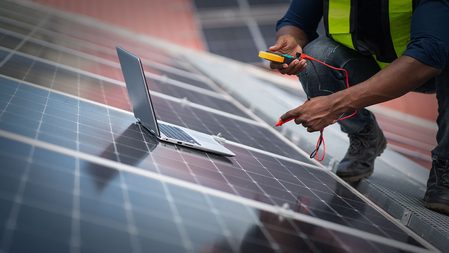
For Ruth Yu-Owen, president and chief executive of renewable energy developer Upgrade Energy Philippines, the answer could be adapting solar financing into a format Filipinos readily understand: something akin to a postpaid mobile phone plan.
She suggested that distribution utilities such as Meralco and electric cooperatives could offer rooftop solar systems through installments bundled into monthly electricity bills, much like telecommunications companies bundle smartphones with postpaid subscriptions. This could make solar more accessible to households unable to afford the upfront investment, while giving utilities another revenue stream.
In fact, Meralco’s solar subsidiary, MSpectrum, already offers two residential plans with no upfront installation payment. One option allows customers to pay for the solar electricity they consume at P2 per kWh less than Meralco’s rate, although MSpectrum retains ownership of the panels.
Users can also go with a subscription plan that charges a fixed monthly fee, with ownership transferring to consumers after the contract ends. But this can be pricey. MSpectrum advertises a 5-kW system starting at P6,499 monthly over 10 years, adding up to P779,880. Over the years, that can be more than thrice as much the P225,000 to P325,000 estimated cost of buying a comparable 5-kWp system outright, though the subscription does include maintenance and insurance.
Meanwhile, neighboring Thailand is taking a more direct approach to affordability. On October 27, its government approved a 50-billion-baht program (P94.50 billion) to subsidize solar installations for 1 million households, offering 50,000 (P94,495) baht per person toward the cost. The program also offers access to financing and allows households to sell excess electricity to utilities at 2.20 (P4.16) baht per kWh.
Even with the subsidy, solar can still be heavy on consumers’ wallets. According to the Bangkok Post, a standard 5-kW system costs up to 140,000 baht (P264,586), meaning households still need to shoulder 90,000 baht (P170,091) after the subsidy.
Such a system could generate savings of about 1,800 to 2,200 baht per month (P3,402 to P4,158), but if a consumer needs to avail of government financing arrangements to cover installation costs beyond the subsidy, then they may have to pay an additional 1,200 baht (P2,268) every month over seven years – leaving actual savings of just around 600 to 1,000 baht (P1,134 to P1,890) per month while paying off the installation.
How rooftop solar can reshape the power system
Pakistan’s experience also shows how regulators can make solar adoption non-disruptive by adjusting electricity rates, especially when rooftop solar grows faster than the grid.
At one solar-heavy grid station in Lahore, the Lahore Electric Supply Company supplied an indicative figure of 95 MW of registered solar capacity. But energy data firm Herald Analytics used satellite imagery and an AI-based geospatial model to estimate that around 177 MW was actually installed across the roughly four-square-kilometer area.
Utilities plan substations, feeders, and future power requirements around assumptions about how much electricity customers will draw from the grid. Solar-powered households rely more heavily on their own solar during the day, then return to the grid in the late afternoon and evening. If actual rooftop capacity is far above what planners assume, both the daytime drop in demand and the evening rebound can be larger than expected.
Pakistan was also carrying long-term take-or-pay contracts with large power plants, meaning fixed capacity payments remained even as rooftop users bought less electricity from the grid.
Waleed described this as a vicious cycle: high electricity prices pushed more consumers toward solar, but as grid sales fell, fixed costs were spread over fewer units, pushing tariffs even higher and making solar more attractive. Solar users also tended to return to the grid during the evening peak, when more expensive plants may have to run.

Pakistan responded in February 2026 by changing its solar rules. Electricity they use from the grid is charged at the normal retail rate, while excess solar they send back after using what they need at home is credited at a lower rate.
Separately, Pakistan also adjusted fixed charges on electricity bills, so households still contribute to grid costs even if they buy fewer units of electricity because they already generate their own solar power. This helps ensure the grid continues to provide stable power to households when they need it.
Though the Philippines has not yet seen the same scale of disruption, the ERC is already planning for the same pressure points.
Chair Juan warned lawmakers in September that growing rooftop solar adoption could “cannibalize” the market of distribution utilities, eventually requiring changes to rate-setting and technical rules.
The ERC plans to revisit the Philippine Distribution Code after completing work on the 2026 Grid Code, including “appropriate interconnection standards” for larger rooftop systems.
The advantage for the Philippines is timing. As the country’s rooftop solar market grows, regulators still have time to make financing more accessible while ensuring grid rules and power contracts can keep pace before the boom leaves some Filipinos behind. – Rappler.com
*PKR 1 = P0.23
ALSO ON RAPPLER
- The Green Report: Going solar in the Philippines
- ‘Solar rush’: Surge in solar demand overwhelms local industry
- Why clean energy is the answer to the Philippines’ power woes
- Clean water flows at a school in Negros Occidental thanks to solar power
- Quezon City eyes solar power for more public buildings after 25 schools
What's Your Reaction?